The medicine problem
I take one tablet a day and the count on the kitchen table came to eight. Eight days. Day 20 is eleven days away. The pharmacy on Main Street had a sheet of paper taped inside the glass and nobody behind the counter.
Eight tablets
The bottle was filled on 9 November. Thirty tablets, one a day. Twenty-four days later there are eight left, and there should be six. I skipped two, on Day 5 and Day 6, because I was counting millilitres and a swallow of water had started to look like a line item. Two tablets saved, and a blood pressure nobody has measured since 23 November, because we own no cuff. That is the mistake.
At 9:40 a.m. I walked to the pharmacy, 1.4 km each way, in −6 °C, on the scraped half of the sidewalk. The paper in the window said the store was closed until power was restored, and gave a phone number for urgent prescriptions. My phone died at 9:20 p.m. on Day 0. The number was ten digits that would have reached a person who wanted a health card number I have never memorised.
There is one pharmacy in the county with a generator: the one inside the grocery store in the next town, 12 km east. That is 24 km there and back, over two hills. The gauge sits just above empty. I have been treating that car as a radio since Day 5. I did not go. The arithmetic was fuel against tablets, and I chose fuel, and I am not certain that was right. At one a day the eighth tablet is Day 17.
The part that annoyed me was smaller than the shortage. The federal emergency kit list on canada.ca asks for a list of every medication, the dose, and what it is for. The tablet is small and white with 10 stamped on one side. I could not name it without the bottle in my hand, and the bottle is the only record of it in the house.
Two to eight degrees
The woman two doors down has been diabetic since 2011. When the grid went down her kitchen fridge was at 4 °C. It has read 6 °C for nine days, which is the same as the room, and 6 °C is not a refrigerator. FEMA puts a closed fridge at about four hours and a full freezer at about 48. Hers stopped being either of those on Day 1.
She had two boxes of insulin pens on the door shelf. I carried them to her garage in a cooler with a thermometer in it. Then we read the leaflet from inside the box out loud at her kitchen table. It was the only authority either of us had.
What the leaflet says:
- Store at 2 to 8 °C. That is the refrigerator, not the freezer.
- In use, a pen can sit at 15 to 30 °C for up to 28 days and still work.
- Do not use insulin that has been frozen. Freezing breaks it and it does not come back.
- After extreme heat or cold, throw it out and replace it.
Her garage reads 2 °C at the back wall and −1 °C at the door, where the wind gets under the frame. I put the cooler on the concrete by the door, because it was out of the sun and farthest from the warm side of the house. At 6 a.m. the thermometer inside it read 1 °C, which is one degree above freezing and two and a half degrees below where the pens started. I moved it onto a shelf, inside a cardboard box, with a folded blanket between it and the wall. That was the second thing I got wrong today. It was the only one that could have cost somebody else something.
My partner's antibiotics were a ten-day course of capsules she finished on 21 November, with three left in the blister. Capsules do not need a fridge. What we did have was a bottle of amoxicillin suspension, half full, label dated March 2024, left over from a course that was stopped early. It spent one week in a fridge in 2024 and twenty months in a drawer after that. Liquid antibiotics are measured in days, not years. It went in the bin.
The rest of the drawer was easier. The ibuprofen said 2019 and had fourteen tablets in it. The FDA's position is that the date is the point to which the maker guarantees full strength and purity, not the day the tablet turns. A degraded tablet can be weaker than its label, and some break down into compounds that are no longer the drug. The aspirin smelled of vinegar, which is what aspirin does when it has hydrolysed, and it went out with the amoxicillin.
Eleven items on the table
I emptied the bathroom cupboard onto the kitchen table and counted, because for nine days I had been telling myself we had a first aid kit.
- 11 adhesive bandages, four of them the 2 cm size that fits nothing
- 0 sterile gauze pads
- 0 pairs of gloves
- 1 roll of tape, three-quarters used
- 1 bottle of ibuprofen, 2019, 14 tablets
- half a tube of ointment
- 1 pair of nail scissors
- 0 thermometers
- 0 cold packs
- 0 saline
- 1 expired bottle of antibiotic suspension
Eleven items, no gauze, no gloves, nothing to clean a wound with. The tape is the only item on the list that would hold a dressing in place, and there is no dressing.
Her kit is a red nylon bag in the hall closet, and she opened it on the table like a toolbox. Four pairs of non-latex gloves. Eight sterile gauze pads in two sizes. Two rolls of bandage. A thermometer. A blood pressure cuff. A pocket mask. An instant cold pack. An emergency blanket. A spare pair of glasses in a hard case with her prescription folded inside it. The Canadian Red Cross list for a basic kit is that plus tweezers, safety pins, an eye pad, scissors and the poison control number, and she had all of it. She checks it every six months and replaces what has expired.
She also had the index card. Six medications, the dose, the time of day, the pharmacy, the doctor, the health card number, in block capitals with a marker. She wrote the first one in 2019 and re-writes it every January. It lives in her purse, not in the house.
I copied the six lines onto the back of a receipt and put the receipt in my coat. Then I wrote ours on the other side, and I had to copy three of the four lines off the bottle because I did not know them.
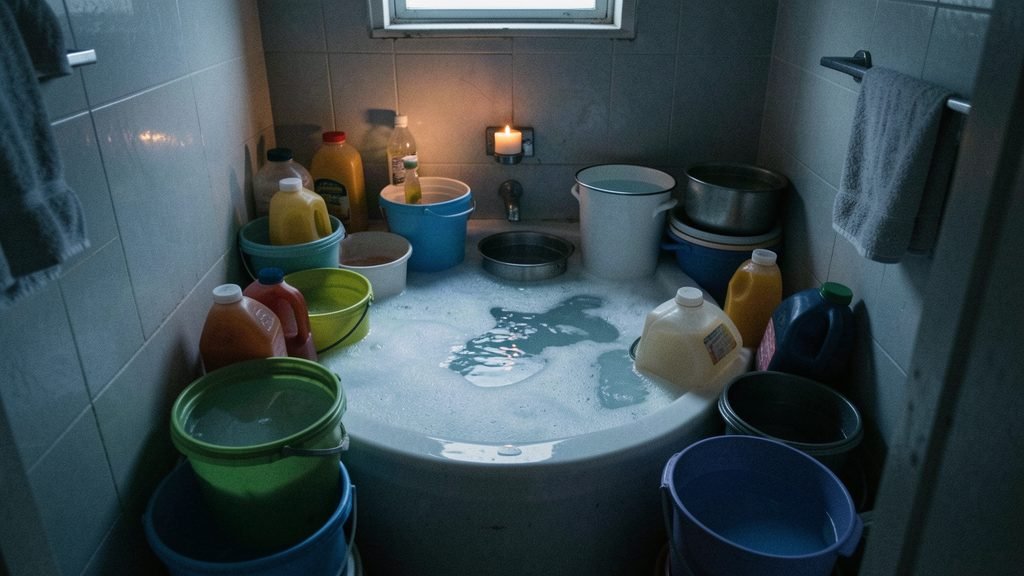
We used 4 L of our own water today. 2.9 L drunk and cooked with, 1 L for the dog, 0.1 L poured over hands before we ate. The rest of the tea came out of her kettle, which she fills from the cistern she has had since 2014. I did not ask how much is left in it. Fourteen litres this morning. Ten tonight.
Her count was worse than mine
The tablets put something in the house that was not here on Day 7. Not fear, exactly. A date. Eight mornings of the small white tablet, and then a gap I could not see the far side of, with no cuff in the house to tell me whether the gap mattered. I did that sum at 2 a.m. and again at 4.
The woman two doors down is further into the same arithmetic than I am. She has been diabetic since 2011, her pens are in a cold garage, and she is counting them the way I am counting tablets. On Tuesday she said so, in one flat sentence, and then asked whether we had salt, because she had two bags and could spare one. Her hands did not move while she said it.
In the years I have lived here I have heard her mention God once, at a funeral. In nine days I have not heard her ask him for anything, or blame him, or explain the storm to me. She looks out of her front window at four o'clock, says it will turn, and sits back down.
I wanted to ask her how she does it. I did not. She did not raise it either. We drank tea and talked about salt, and I carried the bag home and put it in the cupboard and stood in front of the cupboard for a while.
What I should have had on day zero
- A written list of every medication, the dose and the purpose, in a coat pocket. One card, both sides, block capitals.
- A 30-day buffer on the daily tablet, refilled on a date in the calendar rather than on the morning the bottle empties.
- A first aid kit with gauze, tape and gloves in it. Thirty-four dollars at a pharmacy, and none of those three things in this house tonight.
- A thermometer for the room and a separate one for a cooler, nine dollars, so that "cool" is a number and not an opinion.
- One phone number on paper: the pharmacy, the doctor, and the person two doors down.
- FDA — insulin storage temperatures and the 28-day unrefrigerated window
- CDC — managing insulin in an emergency: keep it cool, never frozen
- FDA — expiration dates: what the date on the bottle actually guarantees
- FEMA Ready.gov — power outages: four hours for a fridge, 48 for a full freezer
- Canada.ca — emergency kit: a list of all medications, dosage and purpose
- Canadian Red Cross — first aid kit contents and the six-month check
Get the next day
One email when a new day goes up. No schedule I cannot keep, and no filler in between.
Four days of water is the whole margin. The cheapest fix is a number on the fridge and four jugs with lids.
See the kits →