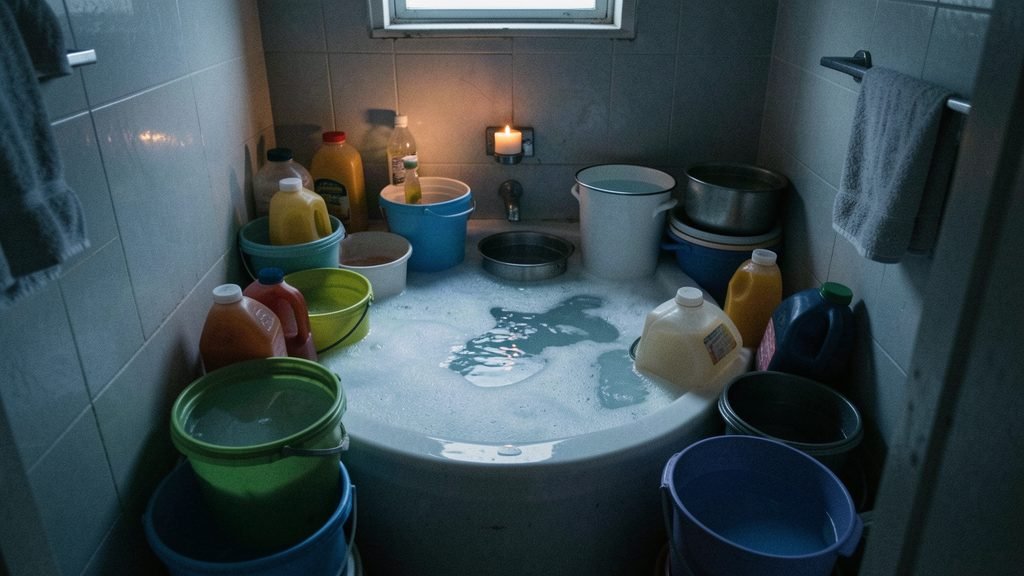
Fifteen litres for four cartridges
We started the day with 8 L of water against a daily draw of 8.6 L. That is 0.93 of a day. I spent the morning hauling snow from the back fence and the afternoon melting it on a borrowed stove, and we went to bed at 14 L.
The eight litres
The arithmetic was on the sheet of paper on the fridge, where it has been since Day 1: litres stored, divided by 8.6. 8 ÷ 8.6 = 0.93 days. Not a week. Not three days. Most of one day, and the day was already half gone.
The 2 L each we agreed to last night lasted until ten, when my partner stood up too fast and had to hold the counter. We went back to 3 L each for drinking and 1.6 L for food, plus the dog's litre. That is 8.6 L, the same number as every day since the second. The cut bought us four litres and cost us a morning.
My hands have started splitting at the knuckles, and I do not notice until they are in water. There is a mug of coffee on the counter I made on Day 4 and did not drink. It is frozen solid and neither of us has thrown it out. My partner has been sleeping in her hat and does not want to talk about the dog's feet, which are cracked from the salt on the porch. At noon we argued about whether to open the second jar of peanut butter. It lasted eleven minutes. That was the day.
So the choice was not whether to melt snow. It was when. Today, in daylight, with the stove already borrowed. Or later, in the dark at −6 °C. I did it today. That is the one decision I got right.
Hauling snow and burning fuel
The snow on the lawn is no good. It sits beside the plow line and comes up grey. The clean snow is at the drift along the back fence, so I carried it: nine trips with the 20 L bucket, 30 m each way, from 12:40 to 2:10. My back was done by the sixth trip and I kept going because the bucket was empty and the pot was not.
The stove is a two-burner cartridge model belonging to the woman two doors down. Ours is propane and there are two cylinders on the shelf. I left them there. They are worth several hot meals and no useful heat, and she has cartridges to spare. It is a debt and I know it.
Her cartridges are butane, which does not pressurise in the cold. At −6 °C the flame came up yellow and half height. I kept the spare inside my coat and swapped them every twenty minutes.
The first pot was a failure I can put a number on. I filled the stock pot with loose snow, packed to the rim, and lit the burner. Forty minutes later I had 300 mL and a scorched ring on the bottom where the snow had touched bare metal. Loose snow is mostly air. A pot the size of a bucket holds almost no water if you scoop it like sugar.
The second attempt: 1 cm of water in the bottom first, then snow packed hard with the back of a ladle, lid on, more snow added as it collapsed. Five refills to a pot. That ran at 18 minutes per litre with both burners going. The first centimetre of water is not a trick. It is the thing that stops the pot burning before there is enough meltwater to carry the heat.
I planned for two cartridges and 20 L. I got 15 L out of four cartridges and stopped. 15 L melted gave 14.6 L in the jugs. Every pour went through a cloth, and 0.4 L went to grit and spill. The first batch tasted of the pot, so I rinsed between batches.
The cost was four cartridges, four hours and ten minutes of burner time, and four degrees in the kitchen. 12 °C down to 8 °C, because the back door opened every twenty minutes.
I ate a mouthful of snow at the fence. It did nothing for the thirst and cost me heat, and I stood in the kitchen for twenty minutes with my hands under my arms before they worked again. Melting snow in your mouth charges the same heat bill as the stove — you pay it out of your body instead of out of a cartridge.
Halfway through the hauling, the arithmetic in my head stopped. I was not thinking about the water, or the radio, or the thing I said to my partner at noon. There was snow, and the bucket, and 30 m, and then snow again. It was the first hour since Day 0 that my mind was quiet, and I did not make it quiet. I have prayed badly since the storm — at night, mostly, asking for the same thing twice. This was not that, and it was not nothing. I do not know what to call it. I carried snow for an hour and a half and something in me sat down.
At about four, with the last pot going, I made myself run it forward. If this is the whole winter — five months, not five days — then snow is not a stopgap, it is the water supply. That makes a filter the most important object in the house and a stove the second. It makes the propane a budget, not a spare. I wrote that on the card. I did not enjoy writing it.
Where the water actually is
I ranked the sources by what they cost.
- Snow. 30 m to the drift. Costs fuel: four cartridges per 15 L, and four degrees in the kitchen.
- The creek. 400 m east, at the end of the street. Water moving under the culvert, ice at the edges, open in the middle. One trip with the 20 L bucket is 25 minutes each way and covers two days. The supply is not the limit. The carry is.
- The well at the old farm. 1.1 km north. Hand-dug, steel plate on top, rope and a bucket. Untested. If that plate has been off since summer, I am not drinking it without boiling it.
- The woman two doors down. She has water stored and six cartridges she would not take money for.
The creek is the one I will use. It is close and it is moving, and moving water is not clean water. It is only water that has not been sitting.
The boiling rule: a rolling boil for one full minute. The CDC puts it at one minute below 6,500 feet, about 2,000 m, and three minutes above. We are at roughly 200 m, so one minute, and I time it now instead of guessing. Cloudy water gets strained through cloth or left to settle, with the clear part poured off. That step is for grit and does not disinfect anything.
Boiling kills bacteria, viruses and parasites. It removes nothing. The sand stays, the salt stays, and anything the creek picked up dissolved upstream stays too.
A filter is a different tool. Filters are rated in microns, and the rating describes the biggest thing that gets through. Bacteria and protozoa are measured in microns. Viruses are measured in nanometres, a thousand times smaller, and a filter rated for bacteria is not rated for viruses. No filter box claims to take out dissolved chemicals.
So the order is filter, then boil. The filter clears the water and makes boiling cheaper. Boiling is the part that makes it safe. I had that backwards for a week. I thought the filter was the safety and the boil was for taste.
What I should have had on day zero
- 4 × 5 L jugs with lids and a spigot, filled, dated, and rotated twice a year.
- 6 butane cartridges, stored above freezing and checked each October when the clocks change.
- A stock pot with a lid and a 1 L measuring jug. I guessed at every volume today.
- A 20 L jerry can and a hand cart for the 400 m to the creek.
- A hollow-fibre filter rated for bacteria and protozoa, and a box of chlorine dioxide tablets for the viruses the filter does not stop.
- FEMA Ready.gov — Water: a rolling boil for one full minute, straining before treatment, and what boiling does not remove
- CDC — How to make water safe in an emergency: boil times by elevation
- CDC — Water treatment options when hiking or camping: boiling, filters, and the filter-then-disinfect order
- Health Canada — Food and drinking water safety in an emergency
- Public Safety Canada — Emergency kits: four litres of water per person per day
Get the next day
One email when a new day goes up. No schedule I cannot keep, and no filler in between.
Four days of water is the whole margin. The cheapest fix is a number on the fridge and four jugs with lids.
See the kits →