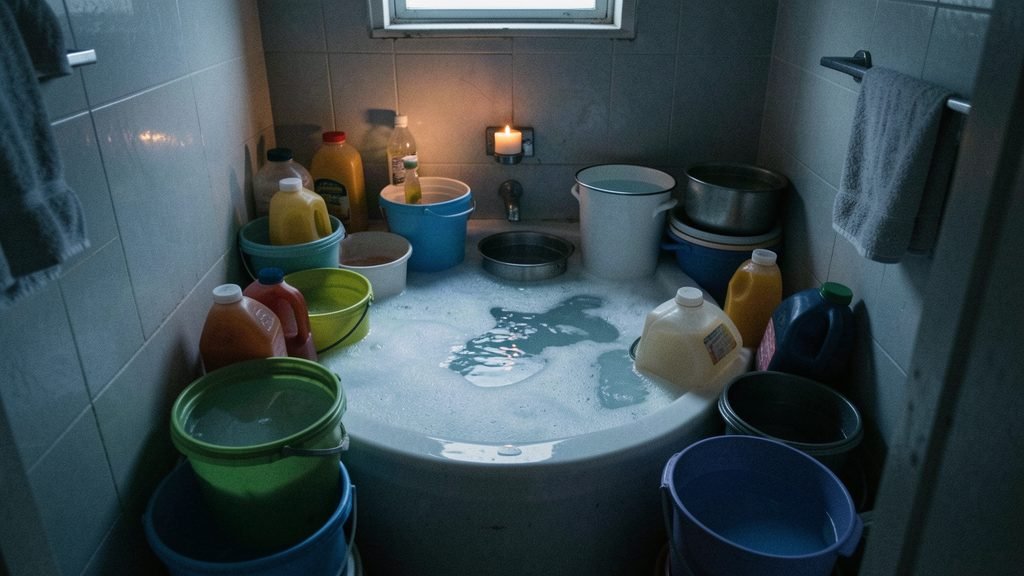
Food that needs no flame
I put everything in the kitchen on the dining table this morning and counted it. Forty-one items, twenty-nine of which need a hob, an oven or a kettle. We are seventy-eight hours into a power cut with 18 litres of water left. Until I counted, I would have told you the food was the part of this I had handled.
The count on the table
The kitchen was 8 °C, one degree below yesterday. It is still the warmest room in the house, because the stove is in it and the stove is doing nothing.
The fridge had been off since 6:40 p.m. on day zero. I cleared it on day two, when the vegetable drawer had an inch of water standing in it. By then I had eaten most of what mattered. That was 750 g of yogurt, 2 litres of milk, the cheese, the ham, and half a lasagne we ate cold out of the dish with two forks. That part I got right. I ate the thawing food first, in the order it would spoil, and I ate it before it spoiled.
What I got wrong was the door. I opened the fridge nine times before noon on day one. Not to take anything out — to look. To confirm it was still cold. By the end of that first day there was condensation on the outside of the door, and I read it as a sign the fridge was holding. It was a sign the fridge was losing.
A closed fridge keeps food safe for about four hours. A closed freezer holds for about 48 hours if it is full and about 24 if it is half full. I knew neither number on day one. I looked them up later, sitting in the car on the driveway with the engine off and 12 percent battery.
Mine was half full, so call it 24 hours. The chicken came out on day two, 1.8 kg of it, raw and warm, and went into the bin because I had no flame to cook it on. The sausages went with it, and two frozen pizzas. Roughly 4,000 calories of food that was not food in any useful sense, because it arrived with a cooking instruction I could not follow.
I put the chicken on the porch first, in the snow, and left it overnight. The porch is not a freezer. The air temperature was +1 °C, and by morning a squirrel had been at the bag. That is the second thing I got wrong. I treated 30 cm of snow as a cold store. The number that matters is the air temperature, not the depth of what is lying on the ground.
The freezer is empty and at room temperature now, so I am using it as a cupboard. The seal shuts properly, which is more than the pantry door does, so the crackers, the bread, the oats and the dog's kibble are in there.
Calories are not morale
Two adults at about 2,000 calories each is 4,000 a day. The dog is 30 kg and gets roughly 1,500 calories of kibble, and there is 3 kg of kibble left, which is four days at his normal ration.
Here is what is actually in the house that can be eaten with no flame:
- 500 g of peanut butter — 32 tablespoons at about 95 calories each, so roughly 3,000 calories
- 400 g of crackers — about 1,900
- Six tins: two tuna, two beans, two peaches — about 1,400 for the lot
- 200 g of cheddar, 150 g of butter — about 1,900
- Six apples, half a loaf of bread — about 1,200
That is about 9,400 calories. The house eats 5,500 a day. So the no-flame food is under two days, in a kitchen I have spent eleven years describing as well stocked.
The rest of the pantry is 2 kg of rice, 1 kg of pasta, 2 kg of flour, 1 kg of oats and four stock cubes. By the packet numbers that is about 21,000 calories, and every one of them needs boiled water. It is not a food store. It is a food store minus the two things I am short of.
The jar of peanut butter is the most useful object in this house today. Ninety-five calories a tablespoon, no water, no heat, and it does not spoil in an 8 °C kitchen. A jar and a sleeve of crackers is a day for one person if the day is a bad one. I have been treating it as the thing you eat when there is nothing else, which is exactly backwards. It is the thing you eat when the stove is the thing that is missing.
Morale is the part I did not plan for. My partner said the only thing she wanted was a hot drink. I have 80 tea bags in the cupboard and no way to boil water. In eleven years I never once noticed those two facts sitting next to each other.
At two in the afternoon I opened a tin of beans and ate them cold, standing at the counter, with a spoon. It took four minutes. I was hungry again by five. That was not hunger, it was the hour, and the cold food did nothing for it. The calories went in and the day still felt like a day with nothing in it.
The water, honestly
18 litres this morning, 12 litres tonight. Six litres out, and this is the first day the number has frightened me.
Two adults drank 4.2 litres between us, a little over 2 each. The dog had 1 litre. Washing hands and rinsing two tins took 0.8. There was no cooking, so there was no cooking water, and that is the only reason the figure is not worse.
My own number, written on day one, was 7.6 litres a day for drinking and cooking for the two of us, plus 1 for the dog. That is 8.6. We used 6. We were 2.6 litres under our own written number, and neither of us was thirsty. I am putting that down plainly because the arithmetic does not care whether we were thirsty. The 2.6 litres did not go anywhere. It just was not drunk, and I did not notice it was missing until I subtracted.
Twelve litres is one and a half days at 8.6. It is less than that if we drink properly tomorrow. We will, because the number is now written on the fridge door in marker.
Tomorrow morning I am walking to the shop on the corner with eleven dollars in my pocket and a quarter tank of fuel in the car. I am going to buy water before I buy anything else, and I am going to count what a dollar buys before I spend it.
The laugh at the freezer
I have not been hungry since the first night. I eat because the clock says so and because the dog sits and watches me do it. The beans went down like a job. Food is fuel now, and I do not miss it, which is the part I did not expect.
The laugh came at the freezer. The kibble is in there, and the dog has decided the freezer is a cupboard. He sits in front of it at four o'clock with his ears up, waiting for it to open. My partner said, without looking up, that he thinks I have moved his dinner into a wardrobe. I laughed until I had to sit down. It was the first time in four days.
Then I did the month on the back of an envelope, without hurrying. At 8.6 litres a day, thirty days is 258 litres. We have 12. The house holds 30,400 calories, five and a half days at 5,500, and the kibble runs out in four days. I wrote the last number down and put the pencil back in the drawer.
What I should have had on day zero
- A fridge thermometer and a freezer thermometer, about $6 each, with 4 °C and −18 °C marked beside them.
- Twenty-four tins that are edible cold — tuna, beans, peaches — instead of six.
- A 30-litre cooler with a lid, and four frozen gel packs in the freezer to put in it.
- 2 kg of peanut butter and 3 kg of crackers: five days for two people with no heat and no water.
- A calorie count taped inside the pantry door: 9,400 without a flame, 21,000 with one.
- USDA Food Safety and Inspection Service — Keep your food safe during emergencies: 4 hours for a closed fridge, 48 hours for a full freezer, 24 for a half-full one
- CDC — Keep food safe after a disaster or emergency: the 4-hour and 2-hour rules, and the 4 °C threshold
- FoodSafety.gov — Food safety during a power outage: what to keep, what to throw out, what can be refrozen
- Health Canada — Food and drinking water safety in an emergency
- FEMA Ready.gov — Food: storing food that needs no refrigeration, cooking or water
Get the next day
One email when a new day goes up. No schedule I cannot keep, and no filler in between.
Four days of water is the whole margin. The cheapest fix is a number on the fridge and four jugs with lids.
See the kits →