Cold at night, and the one warm room
The thermometer by the back door read 9 °C at seven this morning. It read 9 °C at seven last night. It is a cheap digital thing with one battery in it, and the most useful object in the house now.
Nine degrees, measured
I carried it from room to room at 7 a.m. and waited two minutes in each. Kitchen 9 °C. Upstairs hall 7 °C. The two bedrooms 6 °C. Basement 11 °C. Outside, minus 1 °C, and 30 cm of snow that has not moved since the first night.
The house was 12 °C on the first night. It has lost 3 °C in three days, and the basement is the warmest room now, because the ground under it is warmer than the air above. The bathroom on the north wall is the one I am watching. Its cabinet doors are open.
We drank the last of the coffee cold, because heating water costs fuel we have not agreed to spend. My partner put a second sweater on and said nothing about it. We have had one argument in three days, about where the thermometer lives. I wanted it by the back door. My partner wanted it in the bedroom. It is by the back door. The house has no hum now. No fridge, no furnace, nothing ticking. After dark the only sound is the dog breathing.
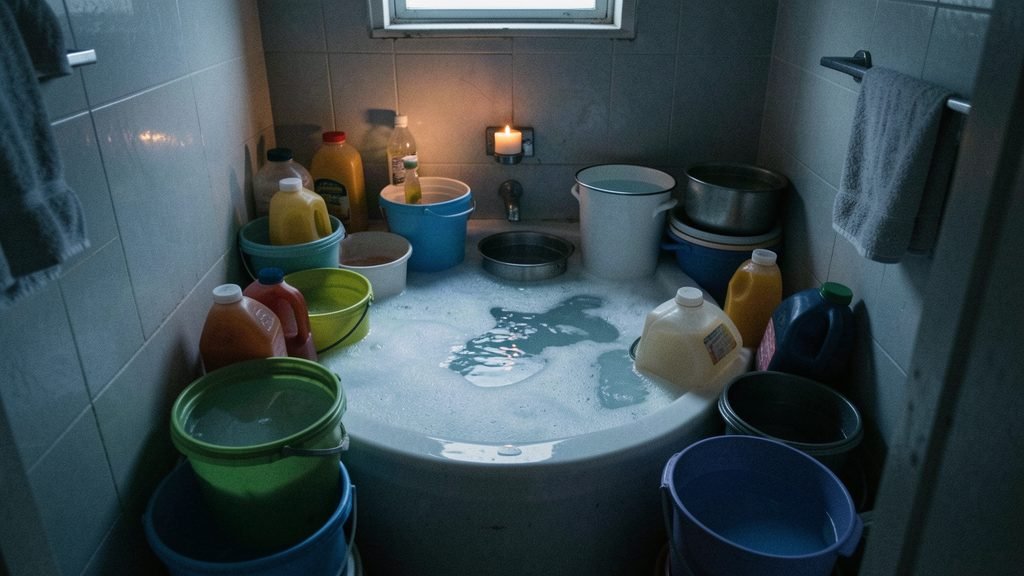
Water: 22 L at the start of the day, 18 L at the end. We used 4 L. Two adults at 1.3 L each, 1.0 L for the dog, 0.4 L for one pot of oats. That is less than half the 8.6 L a day I wrote down on day one, and it is a decision, not a drift. I check urine colour every morning and it has been pale. This is the number my partner and I will argue about on day seven. Nothing was washed today: no bodies, no hair, no clothes. Hands before food still get 200 mL poured from a cup, because that one is not optional.
Why the furnace ran for ninety seconds
Yesterday the power came back for four minutes. Long enough for the furnace to light and the blower to come up. The house gained 1 °C and lost it by dark.
That is the only reason I know the furnace is not broken. It needs power twice: for the ignition and the draft fan, and again for the blower that pushes air through the ducts. Without the blower, the burner heats a sealed box. A limit switch cuts the gas before the box is damaged, which is why it ran about 90 seconds on day one and stopped.
I told my partner the night it went out that the furnace would keep working because the gas was still on. That was wrong. Gas is not heat. Gas plus electricity is heat.
The boiler in the basement is the same problem from the other end. The burner may light, but the circulator pump is electric. Nothing moves, so nothing heats. I did not defeat the limit switch. A furnace with no airflow is a flame in a box with nowhere for the exhaust to go. The CDC says plainly that gas and oil furnaces produce carbon monoxide. That appliance stays off.
Blankets in the doorways
I started in the living room. That was the second mistake of the day. It is 26 m² and it opens onto the stairs and the front hall, so every blanket was fighting a chimney. Two hours and I got it to 8 °C. Then I took the blankets down and moved upstairs.
The back bedroom is 3.2 m by 3.6 m, which is 11.5 m², and at a 2.5 m ceiling that is about 29 m³ of air. This is the tent idea and I had it backwards for two days. A tent is warm because the volume is small and the bodies inside it are the heater. The canvas is not doing the work.
- Three screws above the door frame, a wool blanket hung from them to the floor and 100 mm past the frame on each side.
- A rolled towel along the bottom, where the cold air comes in.
- A second blanket on the hall side, 400 mm away, so the door opens into a gap of still air.
- The window covered with a blanket hung inside the frame. Taped plastic on single glazing collects water, and water at 9 °C runs down and soaks the sill.
- The mattress up on two pallets, 300 mm off the floor. The floor by the window read 7 °C while the bed read 10 °C.
The measurements: 9.5 °C at 6 p.m. with nobody in it. 12 °C at 11 p.m. with two adults and 30 kg of dog inside. 9.5 °C at 6 a.m., against 6 °C in the hall. Layers, since the room is 12 °C at best: wool base, fleece, a down vest, a toque, two pairs of wool socks, mittens rather than gloves. My third mistake was a cotton t-shirt under all of it while I hung blankets. I sweated, the cotton stayed wet, and at midnight it was cold against my skin. I changed at 11 p.m. and slept in dry wool.
The dog would not stay in the room. He came in, turned around twice, pushed back out through the blanket and lay at the top of the stairs, where it is 6 °C. He did that three times before I put his bed against the blanket on the hall side. The room lost 30 kg of heat and I lay awake listening to him breathe on the wrong side of a door.
The car is not the answer
The car has a quarter tank and a heater that blows hot in four minutes. I sat in it for 25 minutes at noon. The needle moved enough to see. That is why the car is not a warm room. Idling spends fuel I need for the trip to town on day five, and puts exhaust under a bedroom window if I park badly.
The neighbour's barbecue is still under a tarp on the driveway where I helped him leave it. At 2 a.m. I thought about bringing a charcoal tray into the basement, just to take the edge off, and I want that written down rather than left out. Burning charcoal indoors gives off CO. The CDC says never, and the people it kills are usually asleep and never get the symptoms that would wake them. I did not do it. I thought about it for ten minutes.
My partner has said maybe 40 words since the morning after. It is not silence as an argument. It is silence as a decision not to spend anything. I have been filling it, badly, and I know I am doing it while I am doing it. Last night my partner said "the water number is wrong" and went to sleep. That was the conversation. The church two blocks up has a bell that rings on the hour. It has not rung since the storm. I noticed that first. Lying there at 2 a.m. I did the arithmetic on whether this is a test, and I do not mean one I can pass. The habit came back before the belief did. I said the thing I say at night. It took nine seconds. I do not know what it was worth, and I am not going to write that it was answered.
If it lasts the winter, the numbers change shape. At 8.6 L a day, 18 L is two days, not a season. Water stops being a supply and becomes a countdown to the first snow melt, which costs the fuel that keeps one room at 12 °C. That makes the trip to town on day five the plan, not an errand. I wrote it down and drew a line under it.
What I should have had on day zero
- 1 thermometer with a battery, and a paper log, 1 line per room per morning.
- 6 wool blankets, not 3. One of mine is a moving blanket that does not hang straight.
- 12 screws and 2 tension rods, so a doorway takes 10 minutes instead of an hour.
- 6 pairs of wool socks and 2 toques, so the dry set is always the dry set.
- 1 carbon monoxide alarm with a battery backup, tested on the day I bought it.
- CDC — Carbon monoxide poisoning basics: indoor charcoal, furnaces, symptoms
- Canadian Red Cross — Power outages: never use charcoal or gas barbecues indoors
- Public Safety Canada / Get Prepared — Power outages: CO alarms, generator distance, frozen pipes
- Health Canada — Extreme cold: hypothermia stages and who is at risk in a house with no heat
- FEMA Ready.gov — Winter weather: layers, frostbite and hypothermia, never heating with an oven
Get the next day
One email when a new day goes up. No schedule I cannot keep, and no filler in between.
Four days of water is the whole margin. The cheapest fix is a number on the fridge and four jugs with lids.
See the kits →