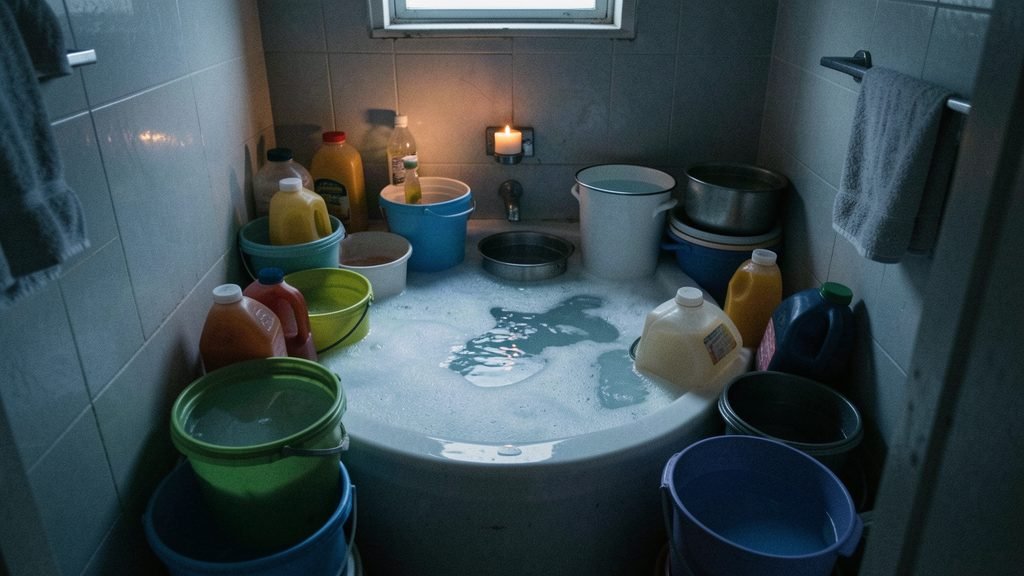
The thaw finds what the freeze broke
At 1:05 this afternoon the porch thermometer read 1.8 °C, the first time it has been above zero since the storm. At 2:20 there was a wet patch 300 mm across on the front hall plaster. By 4:40 I had a hole in the wall, a split pipe and the main shut off.
A bucket under the eavestrough
2.4 °C at 3:50, −7 °C by 10 p.m.: a 9.4 °C swing in nine hours. The eavestrough put 3.2 L in a 4 L bucket by four o'clock, at 19 mL a minute. The house has a sound again: a drip onto the lid of a bucket. I lay awake at nine listening to it.
At 11:00 I walked the house with the torch: front hall 5 °C, kitchen 6 °C, bathroom 5 °C, basement 3 °C. Two runs were on the cold north side, the copper behind the kitchen cabinet and the line to the outside tap.
The dog went out at 12:40 and went for the puddle at the bottom of the driveway, where the road salt runs. I rinsed his paws with 300 mL of washing water, not drinking water. Salt burns a pad.
I did not eat at noon. She put a bowl in front of me at 1:30 and I ate it standing.
6 L came off the north snowbank, not the roof, for the toilet bucket. The eavestrough water went on the ground.
A split in the north wall
The patch was under the front hall shelf. The paint tray under it caught 220 mL by 3:05. There has been no pressure since Day 2, so that water came out by gravity.
At 3:10 I cut a 250 × 300 mm hole with the drywall saw. Then I broke the Day 12 rule. I carried the butane stove to the front hall doorway and lit it, 1 m from the hole, to thaw the joint.
Forty seconds. The flame was 60 mm and I held it 100 mm off the pipe. The plaster above the flame was warm to the back of my hand and there was a smell like a hot iron. The stud was 40 mm behind that pipe. The cavity has dust in it and paper-backed insulation, dry for sixty years. If that had caught, the fire would have started inside the wall, and the nearest water was 24 L in a jug.
I turned it off and carried it out to the step. The card says outdoors. I did it because I was impatient.
We argued for ten minutes about where the tray sat under the pipe. Neither of us said anything about the forty seconds.
Hot water worked. 2 L heated to 62 °C on the stove: 18 minutes, 26 g of gas. Two 1 L bottles and a towel wrapped round the pipe, working from the open end toward the freeze. The upstairs tap open, so the melt had somewhere to go. Rewet the towel every five minutes for twenty-five minutes.
The ice let go at 4:10. 2.6 L ran into the tray over the next forty minutes and then stopped. The split is 22 mm long, along the underside, with ice still in it.
That is what I had wrong for twenty-five days. The freeze did not burst the pipe this afternoon. It split it some time in the last two weeks, the ice plug held the water in, and the thaw is when I found out. Water expands about 9% when it freezes. Copper does not.
At 4:35 I shut the main: 300 mm above the basement floor, house side of the meter, painted over with the wall. 4.5 turns clockwise, then a hard stop, and I stopped with it. The basement tap gave 1.9 L afterwards, so it holds.
The reason to shut it is not the 2.6 L. The town will have pressure before it has anything else, and a 22 mm split with pressure behind it does not stop when the tray fills. It goes into the cavity, down through the floor, and neither of us is home most of the day. Two parts, about $12. I have neither, and the water stays off.
The well across the street
He is on a drilled well: 42 m deep, 125 mm casing, a 240 V submersible pump, a 76 L pressure tank, water at 9 m. In a power cut he has no water. The freeze is his third problem.
Health Canada's guidance is that the pump holds the pressure, and the pressure is what keeps contamination out. During an outage the rule is no taps, no shower, no flushing; every litre drawn pulls the system down. If pressure is lost entirely, the water is tested before drinking. That is his house. Ours has had nothing behind the main since Day 2.
What freezes is the line where it enters through an unheated space, the fittings on the tank, and the pitless adapter at the casing. The order of fixes: bury below frost level, insulate and heat it, or keep it in a heated space. His line comes in under the frost and his tank sits at 4 °C. His pipes were fine.
His generator is what I had wrong about him. 3,200 W will not run a furnace. It will start a half-horsepower pump without breathing hard. Not for a television. He is keeping it for the pump, and that is why 7:55 on Day 13 was always going to be no.
My outside tap is the one that split. The hose has been on it since October, holding water in the bib body, and the body splits at the thread. Cheapest mistake this month: $8 and twenty minutes in a normal year.
What if it comes back
It comes back on a Tuesday afternoon when we are both out walking for water. Pressure arrives in a system with a 22 mm hole in the north wall. It runs until somebody notices, and the somebody will be the woman two doors down, listening to water in my ceiling.
The first hour, whether it is pressure or heat:
- Main off before anything. Front of the basement, 4.5 turns clockwise. The one thing in this house I would run for in bare feet.
- Lowest tap and highest tap open, basement and bathroom, to drain the run and let the air in.
- Walk the ceilings with the torch, under every bathroom and every exterior wall. I have never looked above the kitchen ceiling in eleven years.
- Remember the 50 L heater is empty. Empty since Day 20, so no tank to split at its own fittings.
She came in at 5:20, looked at the hole, and said, "That's been wet since Tuesday." She had seen it and said nothing, because she thought I had. Five minutes later: "Do we have the part?" No. Ten words, both of them the right question.
At 6:20 I was in the basement with the torch on the wet joist and said the prayer my mother said. I got to the middle and could not remember whether it was debts or trespasses, said the wrong one, then started again and got it right. I have said it badly since Day 2. I have not missed a day, which surprises me more than the pipe.
Water: 28 L this morning, 24 L tonight. 8.6 L out, dog's litre included. 4.6 L back in: 31 L of loose snow, boiled three minutes, 74 g of gas at 16 g a litre. The 6 L off the snowbank is not in that number. None of it went near a mouth.
What I should have had on day zero
- A 15 mm push-fit coupling and a pipe cutter, about $12. I would have had this line back on tonight.
- Two 1 L bottles with screw caps kept for hot water, and a towel allowed to be ruined. That is the whole thawing kit.
- The main valve tagged, and turned shut and open once a year, so it is not painted stiff when it matters.
- Foam insulation on the 3 m of copper on the north wall, $9, and the outside tap disconnected in October.
- Health Canada — well safety during and after emergencies: thawing with hot air or steam, burying lines below frost level, and why a well is not drawn during an outage
- USGS Water Science School — water density: ice is about 9% less dense than liquid water, which is the force behind a split pipe
- Ready.gov — winter weather: insulating and sealing the house, and keeping generators outdoors
- Ready.gov — power outages: surge damage to appliances and electronics when power returns
- Canadian Red Cross — emergency preparedness and household kit guidance
Get the next day
One email when a new day goes up. No schedule I cannot keep, and no filler in between.
Four days of water is the whole margin. The cheapest fix is a number on the fridge and four jugs with lids.
See the kits →