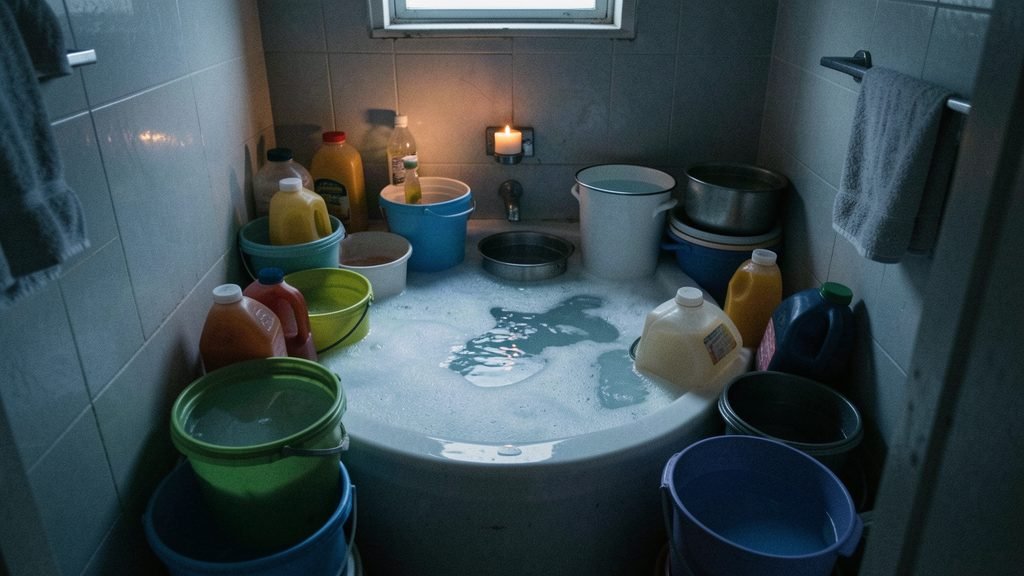
Twenty-one days late, and 3.4 litres on the ice
The church hall two blocks up has been open since Day 3, 8 a.m. to 8 p.m. I walked to it this morning for the first time. 450 m each way, 13 minutes out, and I signed my name on a clipboard by the door at 9:35.
Four hundred and fifty metres
I have been inside that building twice in eleven years, both times for funerals, and I could not have told you where the kitchen was. I have walked to the corner of Third and back most days for three weeks with snow or kindling, and turned around at it every time.
My partner asked me on Day 12 whether I was going. I said there was nothing there I needed. That was not true. I had looked at the place from the road on Day 6 — four cars, a man carrying a kettle in, the door propped with a brick — and decided that a man who has been writing litres on a card for six days does not stand in a line to be counted. For three weeks I melted 72 L of snow for 10.6 L and 168 g of gas rather than walk 450 m to a table with two 4 L jugs on it.
The walk cost 26 minutes. 3.2 km/h on ice, two empty 4 L jugs under one arm, −6 °C, boots and two pairs of socks. The sidewalk at number 31 takes water off a downspout and is ice for 9 m, so I walked that stretch on the road with one hand up.
The dog stood at the door with his weight on his front feet. He is 30 kg and the sidewalk is ice, and I left him.
What was actually in the hall
The thermometer by the kitchen hatch said 18 °C. My living room is 12 °C and the kitchen is 6 °C.
Behind the kitchen there is a 14 kW diesel generator on a trailer, cabled in, and a sheet on the wall with a ruled line for every fill: 61 lines since Day 4. The lights are on, the range works, the urn works, and the furnace fan runs.
Charging is a six-outlet power bar on a folding table and a kitchen timer: twenty minutes each, name and what you are charging on a sheet. A charger draws about 10 W, so twenty minutes is 3.3 Wh against a phone battery of 12 to 15 Wh. You get a quarter of a charge and then somebody else gets the socket. I was fourteenth at 10:00, plugged in at 11:05, and went from 4 percent to 22.
Water is a table by the kitchen door: pallets of 4 L jugs, a clipboard, two per household, name and address. The woman took mine and asked if there was anyone else. I said there was a woman two doors down who could not walk that far, and she wrote a second address under mine.
Food was a 20 L pot of vegetable and barley soup at 11:00, 74 bowls by 12:40, and a bowl of white sugar with a spoon in it, which I looked at for a while, because of Day 15.
Other people: 40 in the hall at ten, 60 by noon. Three of them I had spoken to since the storm, and all three of those conversations were about water.
Information was a whiteboard in three columns — no estimate, crew assigned, restored — with 31 streets on it. Nine restored. Mine under no estimate with 12 others. A printed sheet from the health unit: boil-water advisory for the municipal system, one minute at a rolling boil, no tap water for anything that goes in a mouth. And a line at the bottom in marker: if the generator goes, the hall moves to the arena on Mill Street, 1.4 km further. I copied all of it onto the index card in my coat, including the arena.
The board has two columns
A cork board by the door, a box of push pins, and NO MONEY written across the top in marker by somebody who had already had the argument.
- RIDE to Mitchell's for propane, Thursday 8 a.m., three seats.
- HAVE: chainsaw, 40 cm bar, will cut.
- NEED: six D cells.
I wrote one at 11:40. HAVE: chainsaw, 40 cm bar, will cut — the same as the man two cards above me. NEED: and I stood there with the pen.
Everything I could think of for the NEED column was already being given away 450 m from my kitchen.
I asked the woman at the urn what I owed. She said nothing. I said I was not on the list. She said, "You are now," and wrote my address down for the second time that morning. I asked if I could wash the pot. She said the pot was done and the water for washing was counted.
I took my hat off when I came in. Nobody asked and I did not decide to; my hand went up with it the way it does in a house. The hymn board by the door still had four numbers on it from the Sunday before the storm, 3, 87, 214 and 401. The bell has not rung in twenty-four days, and there were 40 people in that hall at ten in the morning.
I left at 12:05 with four 4 L jugs, 16 kg, because I did not want to walk it twice. That is the day's mistake: two trips of 8 kg would have cost 13 more minutes and I did not want to spend them.
At the corner of Third the sidewalk tilts and I went down on one knee with all of it in my arms. I put my left hand out and it held. The near jug landed on its base seam and split along the bottom. I carried it the last 120 m with water running down my coat, and by the time I got the door open there was 0.6 L left in it. 3.4 L on the ice at the corner of Third, half a day of drinking for this house.
Her two jugs went round before I took my boots off. 8 L, and a 1 L jar with 900 mL of soup in it that the woman at the urn had filled without being asked. She put her hand flat on the jar and left it there. She had one heater cartridge left on Day 15 and she still has one. Then she wrote a card for the board on the back of a prescription: HAVE 2 walking poles, NEED nothing.
The dog put his nose in my cuff where the soup had been and stood there.
I did not pray in the hall. I sat under the hymn board with my hat in my hands, and the empty bottle rolled out of my coat pocket onto the floor, and a man picked it up, read the label, and handed it back without saying anything.
Water at the end of the day: 28 L. Thirty-two at the start, plus 16 from the hall, minus 8 carried to her house, minus 3.4 on the ice, minus 8.6 the way we always do it. The soup came out of another woman's pot, and it is the first hot meal in twenty-four days that did not cost this house a litre of anything.
What I should have had on day zero
- A cloth bag with a shoulder strap, rated 15 kg. $4. Sixteen kilograms of water in two arms does not survive 450 m of ice.
- Four 4 L jugs with screw caps, not two. I have two from Day 5, I borrowed two at the hall, and four would have been one trip and no fall.
- A printed copy of the town's emergency plan and the warming-centre address, off the town website in October, not off a cork board on Day 24.
- A 10,000 mAh power bank, charged on Day 0 and kept for nothing else. That is about three charges without a socket and without a queue.
- 2 kg of coffee, or 40 D cells, so there is something in the HAVE column that another man has not already written.
- Ontario — Emergency preparedness: the municipal emergency plan, reception and warming centres, and what a household plan covers
- Public Safety Canada — Get Prepared: emergency plans, neighbourhood check-ins and designated community facilities
- Health Canada — Food and drinking water safety in an emergency: boil-water advisories and how long to boil
- CDC — How to make water safe in an emergency: boiling as the reliable method when the supply is uncertain
- FEMA Ready.gov — Power outages: charging devices, generator use and keeping food safe during an outage
- Canadian Red Cross — Emergency preparedness and recovery services in Canada
Get the next day
One email when a new day goes up. No schedule I cannot keep, and no filler in between.
Four days of water is the whole margin. The cheapest fix is a number on the fridge and four jugs with lids.
See the kits →