Two hours and ten minutes at a car I could not open
At 8:20 this morning the younger of the two children at number 14 told me the car at the end of the street still had its pre-storm fuel in it. I left at 9:10 with a hose and a 4 L can and came back at 3:40 with both empty. It cost 74 g of gas, 1.5 L of drinking water and 6 h 30 m of daylight.
What a boy of seven knows about a fuel gauge
I was chipping ice off the storm door when he came up the sidewalk. He said the car at the end of the street was still full. His father had said so at supper, and they had filled it on the Thursday, and the family took the other car on the Friday.
I asked him twice, and whether he had seen the gauge himself, and he said his father had. There is a card in my coat with "confirmed or rumour" on it in pencil since Day 6. At 8:30 I decided that a seven-year-old repeating his father at a fence was confirmation. It was one man's remark at a table, carried 200 m up the street by somebody who cannot read a fuel gauge. I had decided before he finished the sentence.
The arithmetic was why. 25 L is 270 km at 9 L/100 km. The pharmacy is 12 km east and has the generator. The hospital is 40 km west, and the lights are somewhere past both.
The house is 1.3 km from the end of the street, 20 minutes on ice at 4 km/h. I took the hose I cut yesterday, the 4 L can, and both gloves. I did not take the sled, which was the only good decision I made before noon.
Two hours and ten minutes
The fuel door opens by hand. The cap came off. The hose went in 200 mm and stopped on something that gave 5 mm and then did not give. Most cars built this century have a mesh or a check valve in the neck. I knew that while I was standing there and kept pushing for ten minutes.
Our car is old enough to take a hose. Theirs is not. That is the whole technical problem, and it took until noon to accept it.
I tried four angles, then a 2 mm galvanised wire bent at the end, which is how a wire gets lost in a fuel tank. I did not lose it. At 11:40 I lay on the snow and looked at the wheel arch where the filler runs down to the tank. I thought about the knife in my pocket for four minutes. The line is under pressure on a fuel-injected engine. I had one bandaged hand, a knife, −6 °C, and a car that is not mine. I put the knife away. That was right, and it was right because I was frightened.
At noon I read the fuel gauge through the driver's window. It said empty. It has said empty since the battery died in the first week, because a gauge is a needle driven by electricity and there is no electricity in that car. I had walked 1.3 km to read an instrument that cannot read. The only number I had was the boy's, from a man who last looked at that car before the storm.
I got one mouthful of petrol at 9:35, spat it out and rinsed with 100 mL from the bottle. It burned in the back of my nose for an hour. The hose came out dry at 12:40 and I walked home.
What the day cost
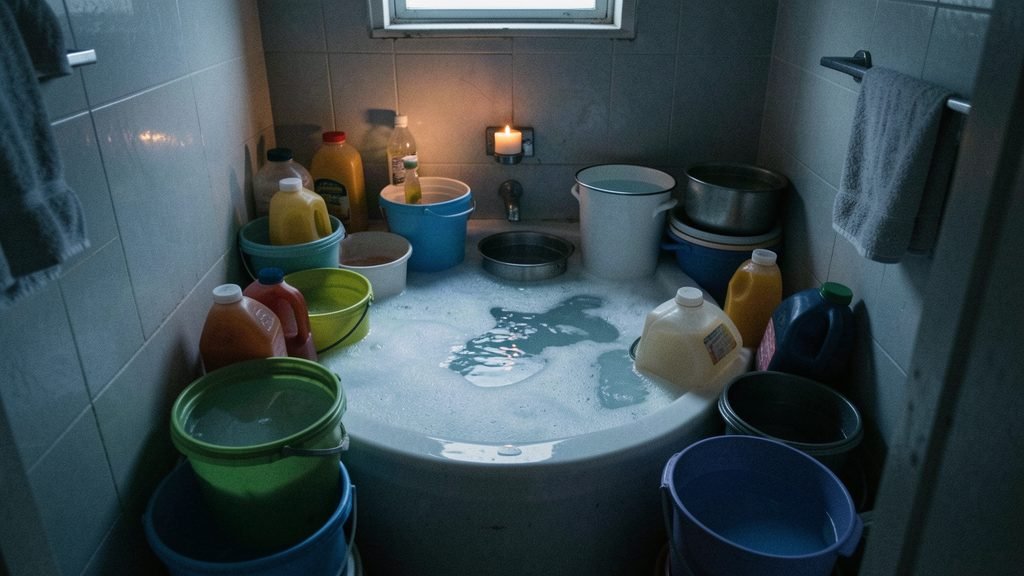
Water: 40 L this morning. 8.6 L through the day as always, 1.5 L of it in the bottle I carried and finished at the corner. At 4:20 I melted 31 L of loose snow for 4.6 L, which is 74 g at the standing 16 g a litre. 36 L tonight.
The cartridge had been in the shed since Day 15 and the flame came up half height. Butane boils at about −1 °C; the shed was at −4, so what was in the can did not want to leave it. Twenty minutes inside my coat brought it back. The melt took 38 minutes against 25 at noon.
The tape lifted off the back of my left hand while I worked the hose. I re-taped at 3:50 with 5 cm. The pink has not crossed the pen line. The knuckle is stiffer, and that is on the card with a question mark.
The room was 11 °C at 8 a.m. and 10 °C at 4 p.m. She was in bed with her coat on from 2:00 to 4:00. The south window had sun from 10:40 to 2:10 and nobody sat in it. Three and a half hours of free heat, spent at a car.
At 1:30 she was at the door and asked if there was any. I said no. "Right." Four words out of her forty, and not another one all afternoon. I would have preferred a row.
The dog knocked the empty can over at the gate at 3:40 and it made a noise like something had happened.
Six-ten
His mother came at 6:10 with the boy behind her on the walk and not at the door. She said, "Don't ask him for things." Then she said the rest, which was worse. That he is seven. That he does not know what a fuel gauge is. That his father had said the thing about the neighbours leaving a car sitting there as a complaint, at a table. The boy carried it up the street because I am the man who gives out hot water.
Then she said her older one had tried that car on the fourteenth, with a length of garden hose, and come home with a cut on his thumb. He could have told me. He was 300 m away and had been carrying the answer for eight days. I did not ask him, or his mother, or his father, or the man across the street with the truck, who would have known in one sentence. I asked the youngest person on the street because he was the one at my fence.
I said I was sorry. She said, "I know," and took him home, and that is not the same as it being all right.
I have run the day forward since. If I had waited until 4:00 his father would have been home. I would have asked him at the fence in ninety seconds and been inside by 4:05 with a fact. Waiting would have cost nothing. That is where I keep arriving: not that I was wrong about the car, but that the right answer was free, on this street, in daylight.
At 5:40 I carried the evening water two doors down and she asked me to carry the bucket out. She stopped asking on Day 15 and I have been carrying it anyway. Tonight she asked. I do not know what that was and I did not ask.
At 9:40 I sat down to say the thing I have said every night since Day 2 and got two sentences in and stopped. The second sentence was me explaining why I had gone. There is no version of it that is not a defence. I did not start again. The clock face two blocks up has no light in it.
Tomorrow she goes up to number 14. She said so at seven, at the sink, four words, and did not ask me to come. I will melt snow and be in the house when she gets back.
What I should have had on day zero
- A 20 L steel fuel can with a spout, empty, in the shed. A 4 L can and a hose is not a plan for a car.
- The owner's manual for both cars on paper, in the house. Mine takes a hose; the one at the end of the street does not.
- Two 450 g cartridges stored above 10 °C, because at −4 °C the flame comes up at half height.
- One page in the back of the water card: eight addresses, who is in each house, who has a truck, who is related to whom. Pencil, week one, 20 minutes.
- CDC / NIOSH — Center for Work and Fatigue Research: what long hours and disrupted sleep do to attention and to the decisions people make
- PubChem (NIH) — Butane: a liquefied gas under pressure, and why a cold cartridge delivers less vapour than a warm one
- FEMA Ready.gov — Power outages: keeping a vehicle tank full before an outage, fuel storage, and generator safety
- Ontario Poison Centre — petrol and other petroleum products swallowed: what to do, and why not to make someone vomit
- CDC — How to make water safe in an emergency: what stored water is for, and what it does not need to be used on
Get the next day
One email when a new day goes up. No schedule I cannot keep, and no filler in between.
Four days of water is the whole margin. The cheapest fix is a number on the fridge and four jugs with lids.
See the kits →