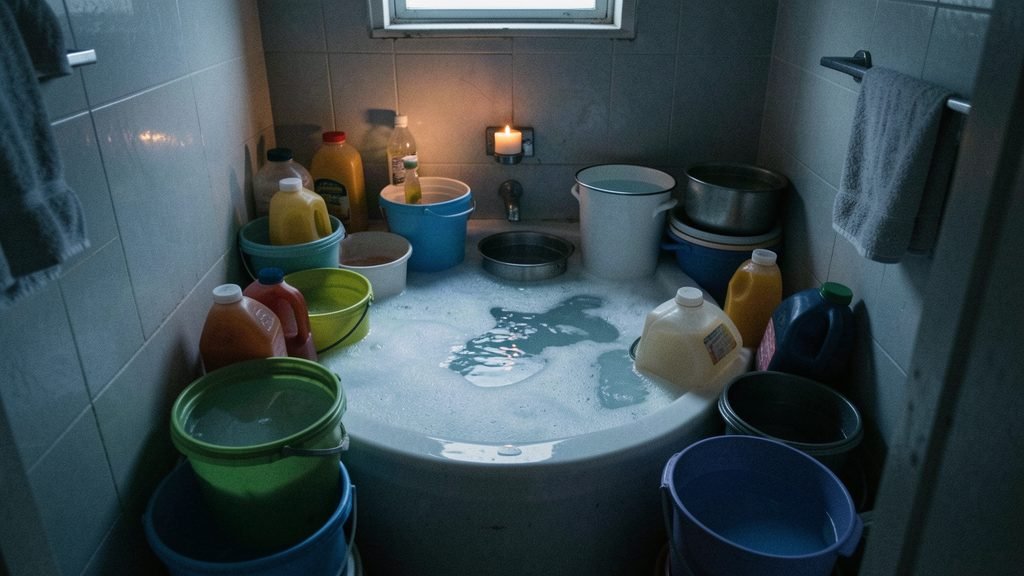
A litre of petrol and nothing that burns it
At 9:10 this morning I cut 3 m off the garden hose and pushed one end down the filler neck of the car. It went in 34 cm and stopped on something hard. The tank has about 1 L in it, and until today I had never tried to reach it.
The hose and the valve
The hose is the green one that has hung in the garage since September, 12 mm across. There is a flap or a ball in the neck of that car, which took forty minutes to find. At 9:35 I tried 8 mm fish tank tube. Same stop.
The mistake was the order. I worked out what the fuel was worth before I checked whether any of it could be got at. Four minutes with a torch and a coat hanger would have told me at 9:00 what I learned at 10:15.
So I went under the car. Cardboard, a 10 mm spanner, a jam jar, and the fuel line where it meets the filter, 40 cm forward of the rear wheel. I cracked the union a quarter turn. It gave up 280 mL in six minutes and stopped: that was what was in the line and filter.
The second mistake was the container. The first half litre went into a 4 L washer jug before I remembered the line I have read a dozen times: fuel goes in a container approved to CSA or ULC. Petrol softens some plastics. That jug had no seal and said washer fluid on the label, and at 11:05 I poured it into the mower can and binned it.
What I got right:
- Driveway, not garage, wind at 15 km/h out of the west. Petrol vapour is heavier than air and pools low.
- I touched the door frame before the can. The coat is nylon and sliding out of the seat in it builds a charge. Bonding and grounding is the guidance; what I did was touch bare metal and hope. No phone in my hand, nothing burning within 6 m.
- I did not put my mouth on the tube. The CDC page on it is four words long. The CCOHS sheet says a mouthful can be fatal, and the mechanism is the lungs, not the stomach.
The rag is in a coffee can with a lid, on the concrete outside the shed door.
What a litre is worth
- Car tank, about 1 L, unreachable through the neck.
- Fuel line and filter, 280 mL, now in the mower can.
- Mower can in the shed, 1.4 L, last filled 2 September. It smells like varnish and it will still burn.
- The neighbour across the street has 20 L in his garage; he gave me the number on Day 13.
1.68 L in my hands. At 1:40 I walked over and asked to buy 5 L. The man across the street said no: the generator is the only thing keeping his pipes from freezing, and he is not carrying 20 L up from the road again. He gave me a coffee and we stood in his porch four minutes talking about the plough.
His tank is 15 L and he runs four hours in the morning and four at night, so his machine drinks close to 1.9 L an hour. That is my division, not his number. On that basis 1.68 L is 53 minutes of his generator. At 3,200 W that is 2.8 kWh, a 1,500 W heater for under two hours.
In this house it is worth 0 hours and 0 L of melted water, because nothing here burns petrol. The stove takes butane cartridges. Petrol in that stove is not a bad idea, it is a way to burn the kitchen down. I wrote that on the card so the idea stops arriving.
The butane is worth 16 g per litre of melt water, because the stove that takes it is on the shelf. The petrol is worth a coffee and four minutes about the plough.
I moved the mower can off the porch shelf, where the jerry can was taken from on Day 10, to the shed: lid on, 6 m from the house, on concrete.
The car
At 3:00 I sat in it for forty minutes. Key to ACC, radio on, eleven minutes of the same bulletin I have heard since Day 6, then off.
The driver's seat is worn through at the left bolster, 40 mm of foam showing. The boot has two bags of road salt, 40 kg, bought last February and never carried down to the basement. Her boots are in the passenger footwell, there since September.
The last time I drove it was Day 5, the 7 km to the shop and back, gauge already at an eighth. The last time the engine ran was Day 12, six minutes, to move it 4 m so the plough could get past the mailbox.
I miss the drive to work. It is 6 km and eight minutes and I did it about 2,600 times and I could name the three potholes on the second line. I miss the hardware store on a Saturday for one screw, coming home with six. I miss the drive-thru on the way back from my mother's, and I missed it at 3:20 this afternoon, which is not worth missing.
The dog got into the boot at 3:15 and would not settle. 30 kg on the salt bags, turning, digging, then his chin on the back seat. He was in before I opened the door.
There is a church bulletin in the door pocket from the Sunday before the storm, with four hymn numbers on the back. I read them, folded it the same way and put it back instead of the recycling.
At 4:10 I said the prayer I learned as a child. It came out like a phone number. I said it again and it came out the same way, and then I stopped, because there was nothing after it.
At 4:40 she came out with two cups, stood at the window and said, "The water is poured. Come in." Six words. I came in.
Five litres a day
45 L at 7:00. Nine days to Day 30. 45 divided by 9 is 5.0. The water card says 8.6 L a day, in pencil; today I wrote 5.0 underneath it with the division next to it.
I put 1.2 L each for drinking. She said no, which is what she does, and she was right: 1.2 is not a ration, it is a guess with a number in front of it. We settled at 1.4 each, 1.0 L for the dog, 0.8 L for cooking and 0.4 L for hands and the pot. That is 5.0 and it holds.
Cooking was one pot of rice and lentils, the water used twice. The dog's litre came out of the jug first, at 7:30, the way it has since Day 2.
No melt today, the first day since Day 8 with no pot of snow on the stove: no 168 g of gas for 10.6 L I did not have to make.
Water at the end of the day: 40 L.
What if this runs past the 30th. 40 L gets us to the end of the month at 5.0 and not one day further. On the 31st the number goes back to 8.6 and the snow goes back in the pot, and the butane decides how long that lasts, and I have not worked out how long that is.
What I should have had on day zero
- One 10 L CSA- or ULC-approved petrol can, full, fill date in marker, rotated every six months.
- A hand-pump siphon with a shut-off clip, about $18, so the mouth is never the tool and a spill is a decision.
- A dual-fuel stove that burns petrol as well as naphtha. It is the only reason to keep petrol in a house with no generator.
- 1 m of 8 mm fuel line and two hose clamps, so a tank can be emptied at the filter instead of at the neck.
- A 2 kg ABC extinguisher within 3 m of wherever fuel is poured, and 10 kg of kitty litter for the spill I did not have.
- CDC — Don't Siphon Gasoline: never use your mouth to siphon gas, and why it makes people sick
- CCOHS — Gasoline: highly flammable liquid and vapour, aspiration hazard, vapour heavier than air
- CCOHS — Garages: fuel safety: approved CSA or ULC containers, grounding and bonding, never siphon by mouth
- CCOHS — Static electricity: why containers are bonded and grounded when flammable liquids are handled
- Ready.gov (FEMA) — Power outages: generator and fuel use outdoors only, and what a generator can and cannot carry
Get the next day
One email when a new day goes up. No schedule I cannot keep, and no filler in between.
Four days of water is the whole margin. The cheapest fix is a number on the fridge and four jugs with lids.
See the kits →