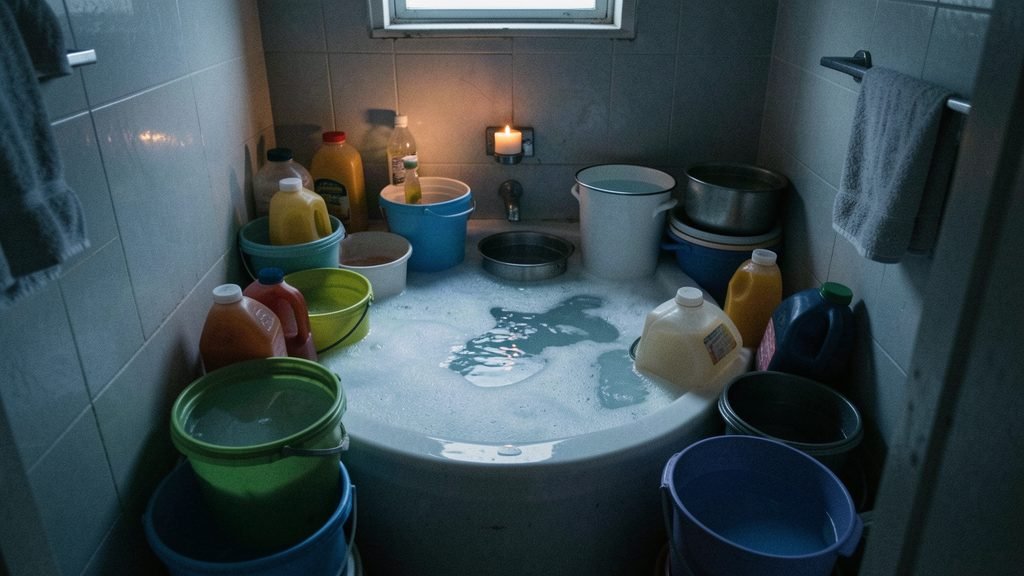
The room hit 14 °C and the air in it was the problem
At 2:10 this afternoon I carried a steel roasting tray of eight burning briquettes into the back room, set it on two bricks, and shut the door so the heat would stay. At 4:20 the room was 14 °C, I had a headache behind my eyes, and the dog had left.
Six degrees and a quarter of a bag of charcoal
The kitchen was 8 °C, the back room 6 °C, upstairs 5 °C. The butane cartridge weighed 195 g, which is five of the meals I cooked on Day 11. I had begun counting it in meals instead of grams, and that is how a person talks himself out of spending it.
The two propane cylinders in the shed were the obvious thing. I did not touch them, because a propane cylinder indoors is how this ends for other people. Charcoal was different: half a bag left from the summer, 2.4 kg when full, $12.99 in July for a barbecue I used four times.
Four briquettes on the kitchen scale came to 318 g. Eight were 636 g, a quarter of the bag, $3.44. I lit them in the kettle barbecue on the driveway at 1:40, waited for grey edges, and carried the tray in at 2:10.
What I said out loud, to my partner, was: it only needs to take the edge off. That is the sentence everybody says.
The room is 3.2 m by 2.8 m by 2.4 m — 21.5 m³. Tray level on two bricks, 40 cm clear of the curtain, door shut, because a shut door is the entire method of heating one room.
The order I did things in
At 3:10 the room was 11 °C and my ears felt full. At 4:10 the dog got up and scratched at the door, which he has done twice in eleven years, both times to go out. At 4:20 the room was 14 °C, the headache sat behind my eyes, and I was mildly sick to my stomach.
Health Canada lists tiredness, headache, flu-like symptoms and shortness of breath at low-level exposure, and adds dizziness, poor vision and difficulty thinking at higher levels. There is no fever with it, and that is the trick: a flu with no fever, in a house where everyone is cold and tired, on day twelve.
I had written that exact line yesterday: CO has no smell, so the only signal is a headache that reads like the flu. I wrote it in the morning and spent the afternoon not reading it.
Our detector is a battery unit in the upstairs hall, 6.5 m from the back room, one floor up, behind a shut door. Ontario's fire code wants an alarm adjacent to each sleeping area, which is where ours is. It did not go off. Not because it is broken. CO has to reach the sensor, and I had put a door and a staircase between the source and the sensor.
The order I actually did things, at 4:22: I carried the tray through the kitchen and out the back door breathing over it, came back in and stood in the room working out where it came from, opened the window, then went up to look at the detector.
The correct order is five lines, now on the cupboard door beside the water card:
- People and the dog outside first.
- Door left open on the way out.
- 9-1-1 from outside the building.
- No re-entry until somebody with a meter gives an actual number.
- The source last, and never indoors again.
What I had backwards is that I treated the room as the problem. Ventilating clears the air. It does not clear what is already in your blood, and it does not tell you whether the air held 30 parts per million or 300. I still do not know which. The detector I bought in 2019 cannot tell me.
We stood on the driveway for fifty minutes. The back room went from 14 °C to 3 °C with the window and door open, the kitchen from 8 °C to 6 °C. I spent $3.44 to be warm for two hours, then spent the warmth.
Four litres, and the jug I did not walk to
Water was 11 L at breakfast and 7 L when I wrote this up. That is 4 L against 8.6 L on the card, and the explanation is not thrift.
The breakdown: 1 L to the dog, 0.6 L to the bucket and a rinse of a pot we did not use, 2.4 L drunk between two adults. I took my tablet at eight with 200 mL, the only measured pour anybody made all day, and after tonight there are four left.
We did not drink it because we were not thirsty. Cold takes the signal away. The jug sits in a hall where the floor is 4 °C, and walking to it is a decision you make twice and then stop making. My urine at six o'clock was the colour of strong tea. That is the cheapest test there is and I did not run it until the day was over.
The missing 4.6 L was not saved. It was water we should have drunk, sitting eight metres away the whole time.
There was no hot meal either. The butane stayed at 195 g. We ate cold lentils out of yesterday's pot, bread and a tin of peaches, and I could not finish mine, so the dog got the rest. At 8 p.m. I ate two crackers because I knew I ought to.
What if I had slept in that room
At eleven in the morning I dragged the foam mattress into the back room and put the dog's bed at the foot of it. That was the plan for the night: one room, one shut door, two people and 30 kg of dog making heat, and the tray lit again at nine.
I cannot write those eight hours. The room was 21.5 m³, the door would have been shut, nobody was going to open it, and there was no alarm on that floor. The thermometer said 14 °C. Nothing in that room measured the air.
My partner came in at 4:30, looked at the tray, and said four words: open both doors. Then she took the dog out. That was most of her speech for the day. She was right and she did not make a thing of it, and I have noticed again that she argues about the water number and not about anything that matters.
At 5:40 I stood in the doorway of that room and was thankful. About ninety seconds later the fear arrived, and it has not entirely gone. It is not fear of the charcoal. It is that the mistake was small — eight briquettes, a shut door, one reasonable sentence about taking the edge off. Nothing I did today was reckless by the standards of a tired man in a cold house.
At 6:15 I walked down to the woman two doors down and asked about her heater. It has never been past her porch, she said. She sits in the doorway with her coat on, feet inside, door open behind her. She said that the way she says everything, as a fact about the weather. Her hall was 7 °C. I stood in it and thought about two warm hours in a room that would have killed me, and about twelve days of being cold in a house that has not.
At seven I went out to the step. The bell two blocks up has not rung since the storm and did not ring then. I did not manage to say anything in particular. Then I came in and wrote DETECTOR on the water card in pencil, under the 8.6, because it is the one thing in this house I look at every day.
What I should have had on day zero
- A CO alarm with a digital display, one on every floor, instead of one $19 unit in the upstairs hall.
- A second alarm for the room we heat, screwed to the wall, not in a drawer.
- The alarm test written on the calendar for the first of every month, and a pencil.
- No charcoal in the house, ever. 2.4 kg of a thing with no safe indoor use, kept because it was for the barbecue.
- A 2 L lidded jug that lives in the warm room, so the water is where the people are.
- Health Canada — Carbon monoxide: overview: no smell, taste or colour, and the fuel-burning devices that produce it, including barbecues and camping stoves used indoors
- Health Canada — Carbon monoxide: symptoms of exposure: tiredness, headache and flu-like symptoms at low levels; dizziness, poor vision and difficulty thinking at higher levels
- Ontario — Carbon monoxide safety: alarms adjacent to each sleeping area, get everyone out and call 9-1-1 from outside, never heat with a stove or oven, never use a barbecue indoors
- CDC — Carbon monoxide poisoning basics: sources, symptoms, and why the alarm is the only warning
- FEMA Ready.gov — Power outages: generators, grills and camp stoves outdoors only, and why a gas range is not a heater
Get the next day
One email when a new day goes up. No schedule I cannot keep, and no filler in between.
Four days of water is the whole margin. The cheapest fix is a number on the fridge and four jugs with lids.
See the kits →