Four centimetres across the back of my hand
At 7:20 this morning a hatchet came off a frozen knot and into the back of my left hand. The cut is 4 cm long and 8 mm wide at its widest. The hospital is 40 km away and the car has 9 L in it.
The step, and the hatchet
The chopping block is 30 cm under snow and frozen into the ground, so I split on the back step: concrete, flat, 3 m from the door.
My left glove was on the porch rail where I left it on Tuesday, frozen into the shape of a hand. The right one had thawed inside. I did not walk back for the other, and that was the mistake that made the rest possible.
Third swing. The round had a knot the size of a walnut, the head turned on it, and the blade came down across the back of my left hand, over the first two knuckles. That hand was holding the round steady, because that is how I split kindling when the block is buried.
The edges sat 8 mm apart. Blood went 2 m across the step and into the snow, and snow makes blood look like more than it is.
The second mistake took ninety seconds. I put the hatchet down and lifted the hand to look, which pulled the wound open and started the bleeding over. Every sheet I have read since says the same thing in the same order: pressure first, look afterwards. I wanted to know how bad it was before I decided anything, which is the wrong order to want things in.
All four fingers moved and all fingertips had feeling. I checked twice.
Nine minutes of pressure
She was at the door before I called her.
She took my wrist, put my hand above my head, and pressed the heel of her hand into a folded tea towel over the cut. Then she said, "Nine minutes," looked at her own wrist, and counted out loud to five hundred and forty. She did not lift her hand once, or let me look.
The bleeding stopped at 7:31. She has done this before. I do not know where, she has not said, and I know which questions get an answer.
She washed her hands with 50 mL from the 2 L bottle and made me wash mine twice, because I had done it badly. Irrigation: 600 mL of stored water in a 2 L pop bottle with three pinholes in the cap, held 10 cm above the wound, poured slowly, twice. Mayo Clinic's guidance is to rinse under running water, not with hydrogen peroxide or iodine. The water came off pink and then not pink.
Then the decision, which is the whole of today.
The wound gaped 8 mm over a knuckle, and a knuckle bends. The CDC's disaster wound sheet says to leave unclean wounds, bites and punctures open, because closing dirt inside is how a wound becomes an infection. We decided this one was clean enough to close: a sharp blade, and the only dirty thing it touched was my own skin. That was a judgement. The same sheet says a wound contaminated with soil should be evaluated by someone who can read the record.
There was no someone. That is the sentence I keep coming back to.
At 7:50 we did the arithmetic. 80 km round trip at 9 L/100 km is 7.2 L, call it 8 with the engine idling. That leaves 1 L in the tank, 30 cm of unplowed snow on the road, 40 km to the hospital, and no way back. If it had been 2 cm lower and taken the tendon, we would have gone anyway.
Her call: close it. Four strips of 1.5 cm tape, 5 cm long, 4 mm apart, each pulled so the edges met, one large bandage over the top, wrapped once with the fingers free.
The third thing I got wrong was the needle. There is black thread in the kitchen drawer and I said I could stitch it. She said no. I said it again. She said, "No. You would push bacteria into it and you would do it badly." She was right, I knew it while I was arguing, and argued another minute anyway.
For sixteen days I have known the litres, the grams, the number on the card. She has spent sixteen days saying forty words a day. This morning she held pressure for nine minutes without moving, made three decisions in four minutes, and got all three right, and I contributed a bad idea about a needle.
At 4 p.m. I walked two doors down. She was up, in the chair by the window. She went to the hall closet and came back with two gauze pads, a pair of gloves and her thermometer without asking anything. She said, "Change it every day and write down what it looks like."
The dog sat by the back door through all of it, then put his chin on my knee and stayed. 30 kg. I did not move for an hour, because moving would have made him get up.
The dressing, and the twenty-four-hour rule
The dressing comes off once a day at 8 p.m. on the kitchen table, under the torch. The CDC sheet says to review the wound every 24 hours. That is the only chart I have, so it goes on the back of the water card in pencil, with the date.
The list is redness, swelling, oozing, increasing pain, then the whole-body ones: fever, breathlessness, fast heart rate, confusion. Tonight the edges were pink for 4 mm, no swelling past the knuckle, ooze clear and small, her thermometer at 36.4 °C.
I drew a line around the pink with a ballpoint, 1 cm out, and dated it. If the redness crosses it, the plan is to walk to the corner and ask the man with the generator for a ride, and either answer costs the last goodwill on this street. Past that there is no plan. I have known since Day 5 that no bad injury in this house reaches a hospital. This is the first time I have written it down.
Tetanus is worse, because it is a date and not a symptom. My last booster was 2017, after a nail through a boot sole. Nine years. The sheet says to have someone determine whether a booster is needed. I wrote 2017 in the margin and left it, the only entry on the card with no number after it.
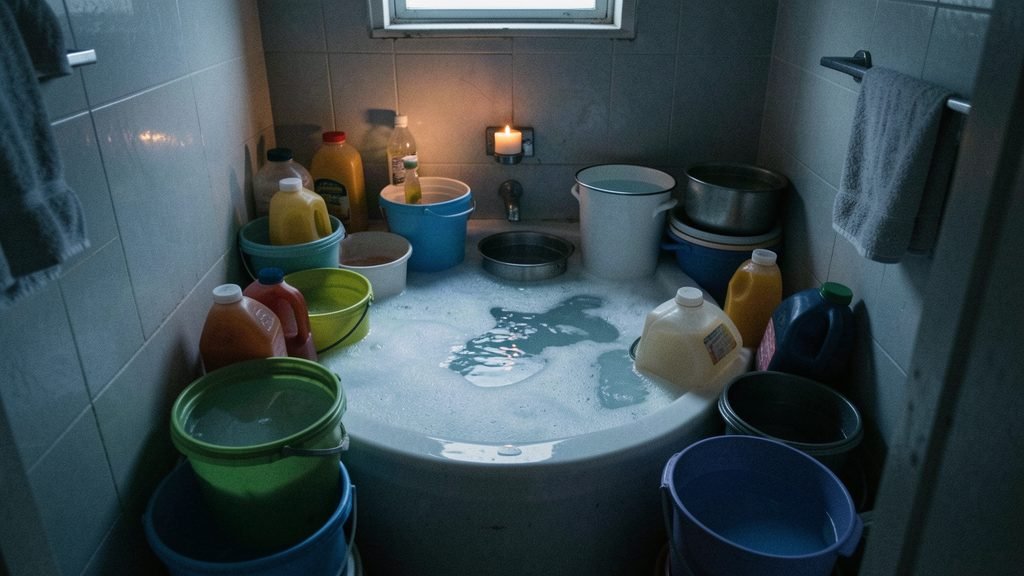
Water: 9 L this morning, 6 L tonight. 0.6 L into the wound, 1.2 L drunk and cooked with, 1 L for the dog, 0.2 L over four washings. The card still says 8.6 L. We are at 3, which is what sixteen days of no resupply allows. The dog still gets his litre. That is the one line I have not moved.
The other cost is the splitting. None today, none tomorrow; the pile that was going to reach Day 24 reaches Day 21.
One tablet left in my bottle after tonight.
At 10 p.m. I sat in the one warm room and did what I have done since Day 7: bargained. Not out loud. I made a list of what I would give up if the hand healed clean, and every item on it was already gone: the fuel, the eleven dollars, the jerry can, the ordinary Tuesdays. I have never once bargained with anyone and got anything. I do it with her, and she says no, and I do it again.
I asked if she had prayed, in the nine minutes. She said, "I counted." I have thought about it for two hours and do not know whether that was an answer.
What I should have had on day zero
- Leather gloves that live inside the door, so there is never a reason to swing with one hand bare.
- Ten sterile gauze pads, two rolls of 2.5 cm tape and four pairs of non-latex gloves. That is the Canadian Red Cross kit list, about $34, and we had none of the three.
- A 500 mL bottle of sterile saline and a clean 2 L bottle with a pinhole cap, about $6.
- My last tetanus date on a card in my wallet. One date, written down, in 2017.
- A first aid manual on paper. The instructions I needed were on a website I could not reach.
- CDC — emergency wound care after a disaster: pressure, cleaning, leaving unclean wounds open, reviewing every 24 hours
- Mayo Clinic — cuts and scrapes first aid: rinse under running water, no hydrogen peroxide or iodine
- Canadian Red Cross — first aid kit contents: gauze, tape, gloves, thermometer, manual
- Canada.ca — tetanus: what the infection does and why vaccination prevents it
- CDC — personal hygiene in an emergency: keeping wounds clean and covered
Get the next day
One email when a new day goes up. No schedule I cannot keep, and no filler in between.
Four days of water is the whole margin. The cheapest fix is a number on the fridge and four jugs with lids.
See the kits →